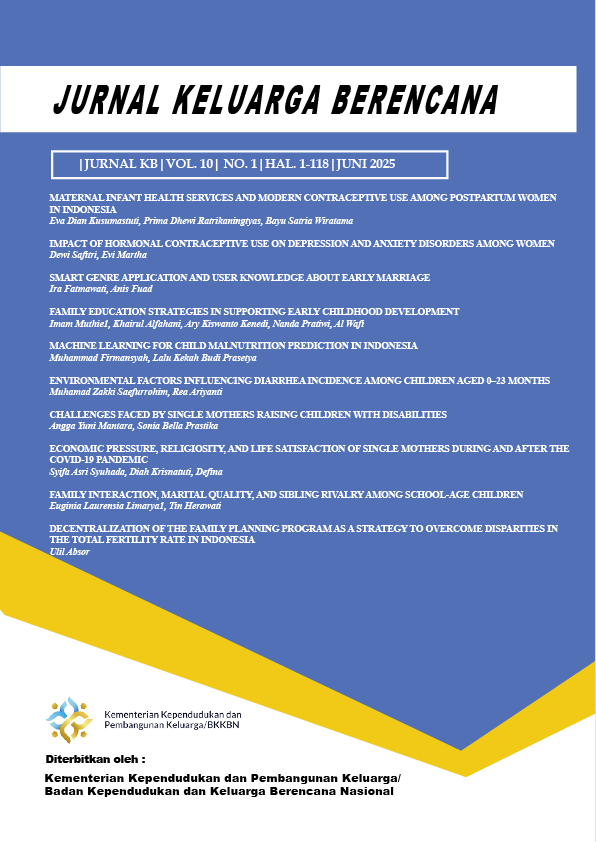
Decentralization Of The Family Planning Program As An Effort To Overcome The Disparities Total Ferlity Rate In Indonesia
DOI:
https://doi.org/10.37306/8ejtkk11Keywords:
Decentralization, Disparities, Family Planning, Indonesia, Total Fertility RateAbstract
This study focuses on the disparity in Total Fertility Totaly Rate (TFR) in Indonesia and explores how decentralization of family planning (FP) programs can be an effective solution. The background of this research is the unequal access to family planning services in different regions, exacerbated by local capacity limitations, dependence on central budgeting, and lack of commitment from local leaders. the objective of this research is to evaluate the effectiveness of decentralization in reducing tfr by bringing family planning services closer to the community. the method is used include secondary data analysis and in-depth interviews with various stakeholders. the research findings indicate that decentralization can enhance community participation and the effectiveness of family planning programs through increased local capacity and innovation. however, the success of decentralization depends on sustained budget support, clear policy frameworks, and enhanced local capacity. in conclusion, decentralization can reduce tfr disparities if supported by strong political commitment and active partiscipation from local communities. the implications of this research highlight the need for a more integrated approach in implementing decentralized family planning in indonesia, with support from technology and adaptive policies to achieve equality in family planning services nationwide
Downloads
References
Adebowale, A. S., Fagbamigbe, F. A., & Afolabi, R. F. (2022). Effects of decentralization on reproductive health services: Evidence from Nigeria. Journal of Reproductive.
Aldrich, D. P. (2012). Building Resilience: Social Capital in Post-Disaster Recovery. Chicago: University of Chicago Press.
Badan Pusat Statistik (BPS). (2021). Survei Demografi dan Kesehatan Indonesia (SDKI) 2021. Jakarta: BPS.
Beauchamp, T. L., & Childress, J. F. (2013). Principles of Biomedical Ethics. Oxford University Press.
Badan Kependudukan dan Keluarga Berencana Nasional (BKKBN). (2022). Profil Kependudukan dan Keluarga Berencana Indonesia. Jakarta: Badan Kependudukan dan Keluarga Berencana Nasional.
Braun, V., & Clarke, V. (2006). Using thematic analysis in psychology. Qualitative Research in Psychology, 3(2), 77–101. https://doi.org/10.1191/1478088706qp063oa
Caldwell, J. C., & Caldwell, P. (2016). The Causes and Consequences of Fertility Decline. Population Studies, 50(3), 283–289.
Central Statistics Agency. (2023). Sensus Penduduk 2020 Long Form (SP2020LF). Jakarta: BPS.
Creswell, J. W., & Poth, C. N. (2017). Qualitative Inquiry and Research Design: Choosing Among Five Approaches. Sage Publications.
Denzin, N. K. (1978). The Research Act: A Theoretical Introduction to Sociological Methods. McGraw-Hill.
Eaton, K., Kaiser, K., & Smoke, P. (2011). The Political Economy of Decentralization Reforms: Implications for Aid Effectiveness. Washington, DC: World Bank.
Gietel-Basten, S. (2022). Demographic resilience in East Asia: Lessons from Japan, South Korea, and Taiwan. Population Studies, 75(4), 255-269.
Hidayat, R. (2019). Desentralisasi dan Kapasitas Pemerintah Daerah dalam Program KB. Jurnal Kebijakan Publik, 14(2), 100-115.
Hull, T., & Mosley, H. (2008). Decentralizing Reproductive Health Services: Challenges and Opportunities in Indonesia. Jakarta: UNFPA.
Hull, T. (2019). Fertility Transition in Southeast Asia: Trends, Determinants, and Policy Implications. Canberra: ANU Press.
Jones, G. (2020). Fertility Decline and Social Change in Indonesia. Population and Development Review, 34(2), 291–321.
Kvale, S., & Brinkmann, S. (2015). Interviews: Learning the Craft of Qualitative Research Interviewing. Sage Publications.
Lincoln, Y. S., & Guba, E. G. (1985). Naturalistic Inquiry. Sage Publications.
Lloyd, C. B., & Mensch, B. S. (1999). Implications of Formal Schooling for Girls’ Transitions to Adulthood in Developing Countries. Social Science & Medicine, 58(9), 1749-1760.
McCarthy, J. (2003). Fertility Control and Family Planning in Indonesia. London: Routledge.
McNicoll, G. (2001). Government and Fertility in Transitional and Post-Transitional Societies. New York: Population Council.
Mills, A., Bennett, S., & Gilson, L. (2019). Health System Decentralization: Concepts, Issues, and Country Experiences. World Health Organization.
Morgan, D. L. (1997). Focus groups as qualitative research. Sage Publications.
Morgan, S. P. (2003). Social Structure and Fertility in Developing Countries. Chicago: University of Chicago Press.
Mutembei, M., & Waweru, M. (2018). Impact of decentralized health systems on family planning: Lessons from Kenya. East African Medical Journal, 95(6), 401–410.
Rondinelli, D. (1981). Government Decentralization in Comparative Perspective: Theory and Practice in Developing Countries. International Review of Administrative Sciences, 47(2), 133–145. https://doi.org/10.1177/002085238004700205
Suharyo, I. (2020). Implementasi Program KB di Era Otonomi Daerah. Jurnal Kebijakan dan Pelayanan Kesehatan, 7(3), 78-91.
Sulaeman, H., & Mustanir, S. (2019). Desentralisasi dan Efektivitas Pelayanan Kesehatan Reproduksi di Indonesia. Jurnal Administrasi Kesehatan, 17(2), 155-172.
Susanto, A., & Anggraini, L. (2015). Desentralisasi Program KB di Indonesia: Tantangan dan Peluang. Jurnal Kesehatan Reproduksi, 9(1), 22-34.
Suyanto, S., & Widodo, W. (2020). The Role of Community-Based Digital Platforms in Reducing Fertility Rates in Decentralized Indonesia. Journal of Public Health Policy, 41(4), 543-556.
United Nations Population Fund (UNFPA). (2022). State of World Population Report. New York: United Nations Population Fund.
Westley, S. B., Choe, M. K., & Retherford, R. D. (2010). Very low fertility in Asia: Is there a problem? Asian Population Studies, 6(1), 3–16. http://hdl.handle.net/10125/16575
World Bank. (2020). World Fertility and Family Planning 2020: Highlights. In World Fertility and Family Planning 2020: Highlights.
World Bank. (2021). World Development Report 2021: Data for Better Lives.
Downloads
Published
Issue
Section
License
Copyright (c) 2025 Ulil Absor

This work is licensed under a Creative Commons Attribution-NonCommercial-ShareAlike 4.0 International License.