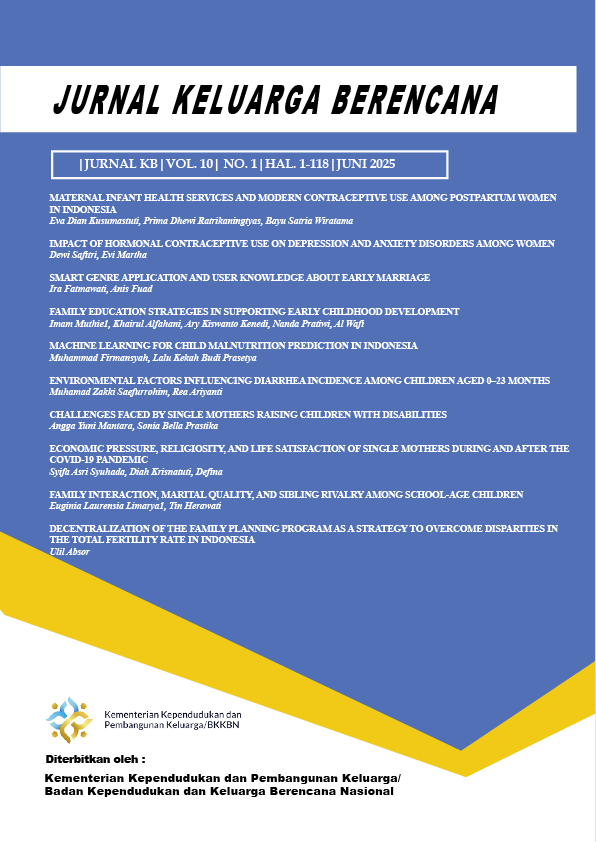
Maternal Infant Health Services and Modern Contraceptive Use Among Postpartum Women in Indonesia
DOI:
https://doi.org/10.37306/d13ck626Kata Kunci:
maternal infant health services, modern contraceptives, postpartum womenAbstrak
Reproductive-age women require effective methods to control the timing of their births and limit the number of children they have. This requirement can be achieved by using modern postpartum contraceptive methods that are provided through maternal and infant health services. This study examined the link between maternal-infant health services and modern contraceptive use among postpartum women aged 15-49, using 2017 Indonesia Demographic and Health Survey (IDHS) data from 6,309 women. A cross-sectional design and logistic regression analyses revealed a positive association: women receiving comprehensive maternal and infant health services were 1.5 times more likely to use modern contraceptives. Other significant factors included education, income, marital status, number of children, pregnancy and delivery services, sexual activity, internet use, family planning discussions, and information from healthcare providers. To improve contraceptive access, BKKBN should strengthen infrastructure, skills training, and field worker coordination. The Ministry of Health should enhance field evaluations of integrated maternal and infant health contraceptive services.
Unduhan
Referensi
Bansal, A., Shirisha, P., Mahapatra, B., & Dwivedi, L. K. (2022). Role of maternal and child health services on the uptake of contraceptive use in India: A reproductive calendar approach. PLoS One, 17(6), e0269170. https://doi.org/10.1371/journal.pone.0269170
BKKBN. (2019a). Laporan Kinerja 2019. https://www.bkkbn.go.id/pages-laporan-kinerja
BKKBN. (2019b). Survei Kinerja dan Akuntabilitas Program KKBPK (SKAP) Remaja Tahun 2019.
Choi, Y. (2018). Estimates of side effects counseling in family planning using three data sources: implications for monitoring and survey design. Studies in family planning, 49(1), 23-39.
Coomson, J. I., & Manu, A. (2019). Determinants of modern contraceptive use among postpartum women in two health facilities in urban Ghana: a cross-sectional study. Contracept Reprod Med, 4, 17. https://doi.org/10.1186/s40834-019-0098-9
Darroch, J. E., Sully, E., & Biddlecom, A. (2017). Adding it up: Investing in Contraception and Maternal and Newborn Health, 2017—Supplementary Tables. New York, NY: The Guttmacher Institute. https://www.guttmacher.org/fact-sheet/adding-it-up-contraception-mnh-2017
Dev, R., Kohler, P., Feder, M., Unger, J. A., Woods, N. F., & Drake, A. L. (2019). A systematic review and meta-analysis of postpartum contraceptive use among women in low- and middle-income countries. Reprod Health, 16(1), 154. https://doi.org/10.1186/s12978-019-0824-4
Dixit, P., Dwivedi, L. K., & Gupta, A. (2017). Role of maternal and child health care services on postpartum contraceptive adoption in India. Sage Open, 7(3), 2158244017733515.
Do, M., & Hotchkiss, D. (2013). Relationships between antenatal and postnatal care and post-partum modern contraceptive use: evidence from population surveys in Kenya and Zambia. BMC Health Serv Res, 13, 6. https://doi.org/10.1186/1472-6963-13-6
Ekawati, N., & Herdayati, M. (2020). Apakah akses internet berhubungan dengan penggunaan kontrasepsi modern pada perempuan generasi millennial di Indonesia? Prosiding Forum Ilmiah Tahunan (FIT) IAKMI,
Ekoriano, M. (2018). The Dynamics of Modern Contraceptive Use in Indonesia (Analysis of Susenas 2015 Data). JURNAL KEPENDUDUKAN INDONESIA, Vol. 13 No.1, 27 - 38.
Ekoriano, M., Rahmadhony, A., Prihyugiarto, T. Y., & Samosir, O. B. (2020). Hubungan Pembangunan Keluarga Dan Pemakaian Kontrasepsi Di Indonesia (Analisis Data SRPJMN 2017). Jurnal Keluarga Berencana, 5(1), 1-15.
Fatmawati, H., & Martha, E. (2022). Determinants of the Use of Traditional Contraceptive Methods in Indonesia (2017 IDHS Data Analysis). Jurnal Ilmu Kesehatan Masyarakat, 13(3), 334-349.
Götmark, F., & Andersson, M. (2020). Human fertility is influenced by factors such as education, economy, religion, contraception, and family planning programs. BMC Public Health, 20(1), 265. https://doi.org/10.1186/s12889-020-8331-7
Gupta, M., Bansal, A., Chakrapani, V., Jaiswal, N., & Kiran, T. (2023). The effectiveness of prenatal and postnatal home visits by paramedical professionals and women's group meetings in improving maternal and child health outcomes in low and middle-income countries: a systematic review and meta-analysis. Public Health, 215, 106-117. https://doi.org/10.1016/j.puhe.2022.11.023
Hale, N., Picklesimer, A. H., Billings, D. L., & Covington-Kolb, S. (2014). The impact of Centering Pregnancy Group Prenatal Care on postpartum family planning. Am J Obstet Gynecol, 210(1), 50.e51-57. https://doi.org/10.1016/j.ajog.2013.09.001
Hameed, W., Azmat, S.K., Ali, M., Sheikh, M.I., Abbas, G., Temmerman, M., & Avan, B.I. (2014). Women's empowerment and contraceptive use: the role of independent versus couples' decision-making, from a lower-middle-income country perspective. PLoS One, 9(8), e104633. https://doi.org/10.1371/journal.pone.0104633
Harzif, A. K., Shadrina, A., Yo, E. C., Reviani, N., & Hestiantoro, A. (2023). Influence of internet, mobile phone use, and sociodemographic factors on women's Knowledge and attitude towards contraception in Indonesia. Obstet Gynecol Sci, 66(1), 42-48. https://doi.org/10.5468/ogs.22277
Huang, M., Gutiérrez-Sacristán, A., Janiak, E., Young, K., Starosta, A., Blanton, K., Azhir, A., Goldfarb, C. N., Kuperwasser, F., Schaefer, K. M., Stoddard, R. E., Vatsa, R., Merz-Herrala, A. A., & Bartz, D. (2024). Contraceptive content shared on social media: an analysis of Twitter. Contracept Reprod Med, 9(1), 5. https://doi.org/10.1186/s40834-024-00262-2
IDHS. (2018). Indonesia Demographic and Health Survey 2017.
Kemenkes. (2021). Peraturan Menteri Kesehatan Republik Indonesia Nomor 21 Tahun 2021 Tentang Penyelenggaraan Pelayanan Kesehatan Masa Sebelum Hamil, Masa Hamil, Persalinan, Dan Masa Sesudah Melahirkan, Pelayanan Kontrasepsi, Dan Pelayanan Kesehatan Seksual Kementerian Kesehatan Republik Indonesia Retrieved from https://www.persi.or.id/images/regulasi/permenkes/PMK-212021.pdf
Kirana, K., & Idris, H. (2022). Determinants of Modern Contraceptive Use Among Married Women in Urban Indonesia. Jurnal Ilmu Kesehatan Masyarakat, 13(1), 85-96.
Lasong, J., Zhang, Y., Gebremedhin, S. A., Opoku, S., Abaidoo, C. S., Mkandawire, T., Zhao, K., & Zhang, H. (2020). Determinants of modern contraceptive use among married women of reproductive age: a cross-sectional study in rural Zambia. BMJ Open, 10(3), e030980. https://doi.org/10.1136/bmjopen-2019-030980
Lopez, L. M., Grey, T. W., Hiller, J. E., & Chen, M. (2015). Education for contraceptive use by women after childbirth. Cochrane Database Syst Rev, 2015(7), Cd001863. https://doi.org/10.1002/14651858.CD001863.pub4
MacQuarrie, K. L. D., & Aziz, A. (2022). Women’s decision-making and contraceptive use in Pakistan: an analysis of Demographic and Health Survey data [Article]. Sexual and Reproductive Health Matters, 29(2), Article 2020953. https://doi.org/10.1080/26410397.2021.2020953
Maldonado, G., & Greenland, S. (1994). Simulation Study of Confounder-Selection Strategies. American Journal of Epidemiology, 138, 923-936.
Mruts, K. B., Tessema, G. A., Gebremedhin, A. T., Scott, J. A., & Pereira, G. (2022). The role of family planning counselling during maternal and child health services in postpartum modern contraceptive uptake in Ethiopia: A national longitudinal study. PLOS Glob Public Health, 2(8), e0000563. https://doi.org/10.1371/journal.pgph.0000563
Negash, W. D., Eshetu, H. B., & Asmamaw, D. B. (2022). Predictors of modern contraceptive use among reproductive age women in high fertility countries in sub-Saharan Africa: evidence from demographic and health surveys. BMC Women's Health, 22(1), 520. https://doi.org/10.1186/s12905-022-02121-1
Polis, C., Bradley, S. E., Bankole, A., Onda, T., Croft, T. N., & Singh, S. (2016). Contraceptive failure rates in the developing world: an analysis of demographic and health survey data in 43 countries.
Priskatindea, & Ronoatmodjo, S. (2021). Hubungan Tingkat Pengetahuan Tentang Alat KB dengan Pemakaian Kontrasepsi Modern pada Wanita Remaja Kawin di Pulau Jawa (Analisis SDKI 2017). Jurnal Epidemiologi Kesehatan Indonesia, Vol. 5. https://journal.fkm.ui.ac.id/
Shah, I. H., Santhya, K., & Cleland, J. (2015). Postpartum and post‐abortion contraception: from research to programs. Studies in family planning, 46(4), 343-353.
Sonalkar, S., Mody, S., & Gaffield, M. E. (2014). Outreach and integration programs to promote family planning in the extended postpartum period. Int J Gynaecol Obstet, 124(3), 193-197. https://doi.org/10.1016/j.ijgo.2013.09.021
Tessema, G. A., Mekonnen, T. T., Mengesha, Z. B., & Tumlinson, K. (2018). Association between skilled maternal healthcare and postpartum contraceptive use in Ethiopia. BMC Pregnancy Childbirth, 18(1), 172. https://doi.org/10.1186/s12884-018-1790-5
WHO. (2016). WHO recommendations on antenatal care for a positive pregnancy experience.
WHO. (2018). WHO Recommendations: Intrapartum care for a positive childbirth experience. In. https://www.ncbi.nlm.nih.gov/books/NBK513802
WHO. (2022). WHO recommendations on maternal and newborn care for a positive postnatal experience https://www.ncbi.nlm.nih.gov/books/NBK579653/
WHO, USAID, & MCHIP. (2013). Programming Strategies for Postpartum Family Planning. WHO Library Cataloguing in Publication Data Retrieved from https://apps.who.int/iris/bitstream/handle/10665/93680/9789241506496_eng.pdf
Wilopo, S. A., Setyawan, A., Pinandari, A. W., Prihyugiarto, T., Juliaan, F., & Magnani, R. J. (2017). Levels, Trends and Correlates of Unmet Need for Family Planning among Postpartum Women in Indonesia: 2007-2015. BMC Women's Health, 17(1), 120. https://doi.org/10.1186/s12905-017-0476-x
Yimam, A., Fisseha, G., Kalayu, M., & Anbesu, E. W. (2021). Contraceptive Use and Its Associated Factors among Women Who Gave Birth within 12 Months in Dubti Town, Pastoral Community, of Afar Region, Northeast, Ethiopia. J Pregnancy, 2021, 6617189. https://doi.org/10.1155/2021/6617189
Zegeye, B., Idriss-Wheeler, D., Ahinkorah, B. O., Ameyaw, E. K., Seidu, A. A., Keetile, M., & Yaya, S. (2022). Individual, household, and community-level predictors of modern contraceptive use among married women in Cameroon: a multilevel analysis. Int Health, 14(6), 648-659. https://doi.org/10.1093/inthealth/ihab092
Zimmerman, L. A., Yi, Y., Yihdego, M., Abrha, S., Shiferaw, S., Seme, A., & Ahmed, S. (2019). Effect of integrating maternal health services and family planning services on postpartum family planning behavior in Ethiopia: results from a longitudinal survey. BMC Public Health, 19(1), 1448. https://doi.org/10.1186/s12889-019-7703-3
Unduhan
Diterbitkan
Terbitan
Bagian
Lisensi
Hak Cipta (c) 2025 Eva Dian Kusumastuti; Prima Dhewi Ratrikaningtyas, Bayu Satria Wiratama

Artikel ini berlisensiCreative Commons Attribution-NonCommercial-ShareAlike 4.0 International License.